
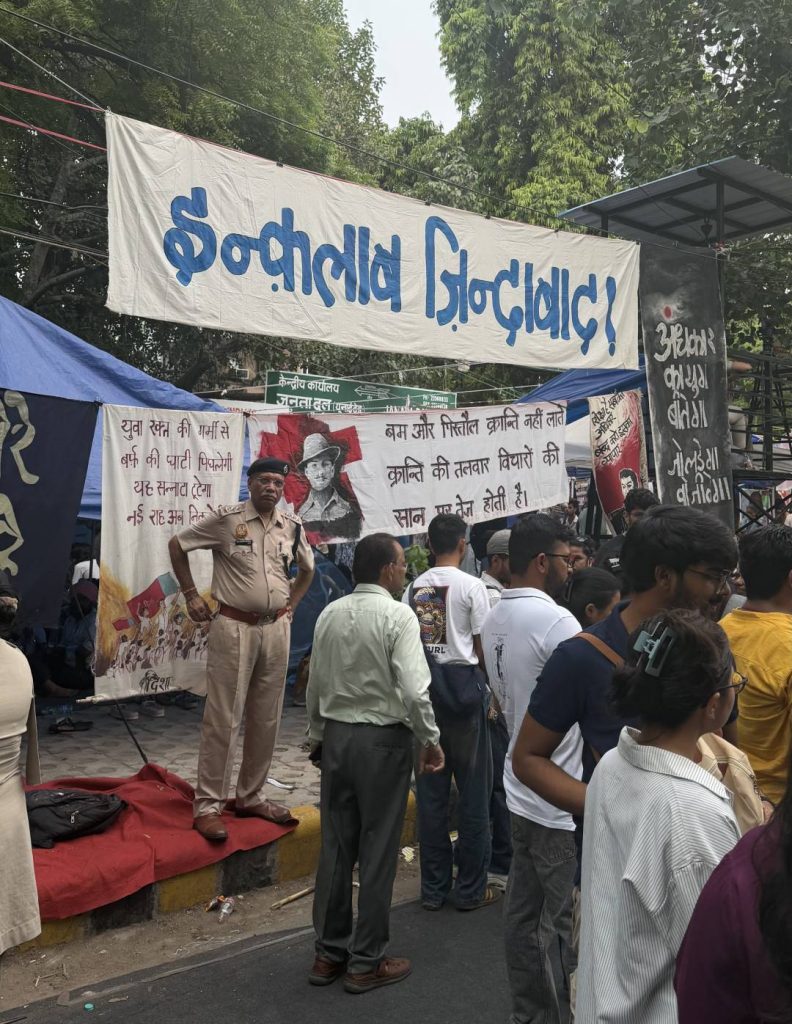
The Cockroach Janta Party (CJP) protest at Jantar Mantar in New Delhi was quite unprecedented, and not least because it managed to make a Bharatiya Janata Party (BJP) minister resign. First, the protest broke the spiral of silence. The spiral of silence is a social scientific theory[1] Noelle‐Neumann, E. (1974). The Spiral of Silence: A Theory of Public Opinion. Journal of Communication, 24(2), 43–51. that explains why a small section of Indians was vocally critical of prime minister Narendra Modi and his government — primarily the politically aware leftists and liberals — while the majority either remained silent about their true opinion or pretended to support Modi.
People tend to get a feel for their social environment before expressing political opinions due to the fear of isolation. According to the scholar Elisabeth Noelle-Neumann, who propounded the spiral of silence theory in the 1970s, they generally look up to the mass media as the barometer of public opinion and accordingly figure out what the dominant (hence acceptable) public opinion is before expressing their own opinion on sensitive issues. (I’d claim social media has displaced mass media as the barometer for public opinion in our times.)[2]The avant-gardes and the hardcores, though, do not get swayed by public opinion. But they tend to be a minority in a society.
The CJP protests opened the floodgates for dissent and made people realise that the opinions they secretly held were actually widely shared. Until last year Modi seemed to possess an impenetrable aura, but post the CJP protest, he has been waking up everyday to a torrent of abuses and invectives. It isn’t that the public opinion about Modi has radically shifted overnight but rather people’s perception of what the dominant public opinion of this country is, has shifted.
The rise of the CJP has been unprecedented for other reasons as well. As a digitally born mobilisation, it shares quite a few characteristics with other similar mobilisations in the recent past such as the Arab Spring, Occupy encampments, Hong Kong’s umbrella protests, #metoo, and India’s Nirbhaya and the CAA/NRC[3]CAA stands for Citizenship (Amendment) Act; NRC stands for National Register of Citizens. protests. These mobilisations emerged as a response to an atrocious act, an unjust government policy or a spark lit on social media. They tapped into a wider feeling of disgruntlement, pent-up grievances and state failure, leading to a sudden burst of momentum that brought seasoned activists and newbies together.
In the internet-enabled protests of the last two decades, it has been observed that the mobilisations lack an organisational structure that can steer the protest activity. Protestors use social media and private messaging apps to plan their tactical moves and decide the momentum of the protests. Scholars have made a note of these characteristics — the absence of designated leaders, horizontal decision-making structures (especially in the Occupy encampments), and the distributed authority. Sociologist Zeynep Tufekci, in her book Twitter and Tear Gas: The Power and Fragility of Networked Protest, terms this phenomenon ‘adhocracy’ explaining how in these mobilisations, “tasks can be accomplished in an ad hoc manner by whoever shows up and is interested.”
The CJP protest radically differs from these mobilisations on this point. I was quite amazed at how quickly the CJP, as a digitally born campaign, put together an organisational structure, assembled a core team and assigned tasks to the team members. Further, the campaign, in Abhijeet Dipke, had a visible and universally accepted leader from the very beginning.
The CJP mobilisation fundamentally challenges the accepted wisdom of the last two decades regarding the role of leaders in internet-enabled mobilisations. The CJP protest at Jantar Mantar has shown that the contemporary mobilisations will not necessarily be leaderless, with authority dispersed among multiple and not necessarily connected actors.
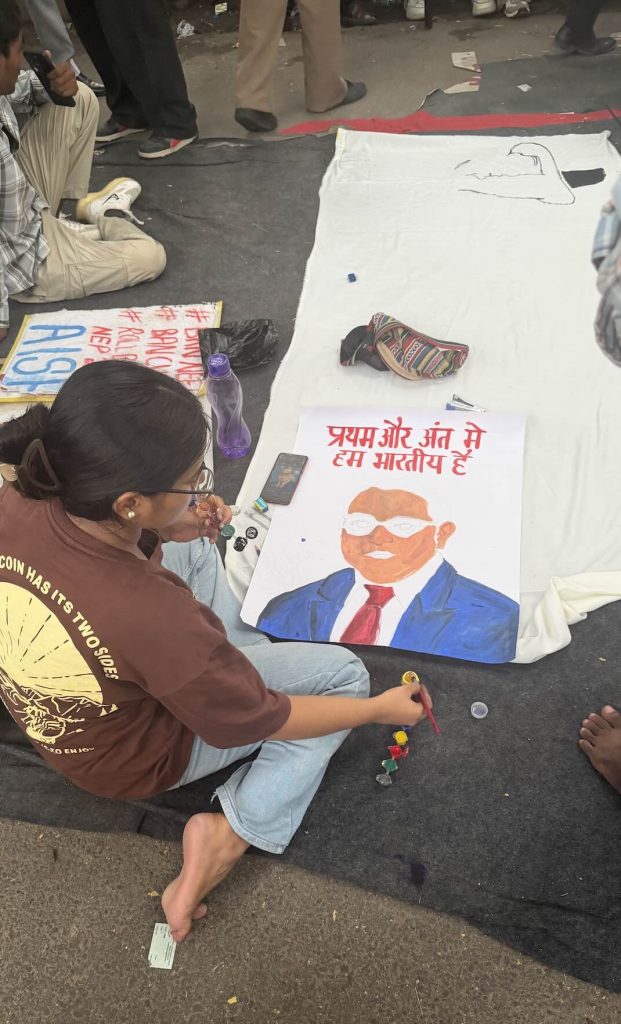
It, however, must be pointed out that in protest events leadership is not necessarily a virtue or a vice. As with a lot of other things in social movements and mobilisations, it has its pros and cons. As soon as a protest event becomes a threat to the state, the state machinery gets into action to suppress and delegitimise it. These efforts include trying to buy off the leaders, threaten and intimidate them, put them in jail, even murder them in extreme cases (remember Martin Luther King Jr), and engage in their character assasination. Once the original leadership gets compromised, it is difficult to find a replacement for them. Another drawback is that a centralised authority structure can result in short-sighted decisions since there are only a few heads deliberating on tactics, strategy and public communication.
At the same time, leaders offer some important benefits to a mobilisation. When the state agrees to sit at the negotiation table, they know whom to approach. The protestors also have their trusted people at the table to represent their grievances and get their demands met. Additionally, the centralised authority makes uniform messaging possible and gives a definite direction to the mobilisation. Lastly, the leadership takes responsibility for planning, strategising and distributing tasks, which can make mobilisations a much more of an organised activity.
We saw all of these things play out in the CJP protest at Jantar Mantar. The mobilisation had a clear messaging and properly assigned roles for various core tasks. When the Modi government realised the massive strength of the mobilisation and the popular support for it, it started negotiating with the CJP core team. At the same time, since the protest had designated leaders, the pro-government news media, the BJP IT cell and the ruling party members had a clear target to engage in a propaganda campaign to delegitimise the mobilisation.
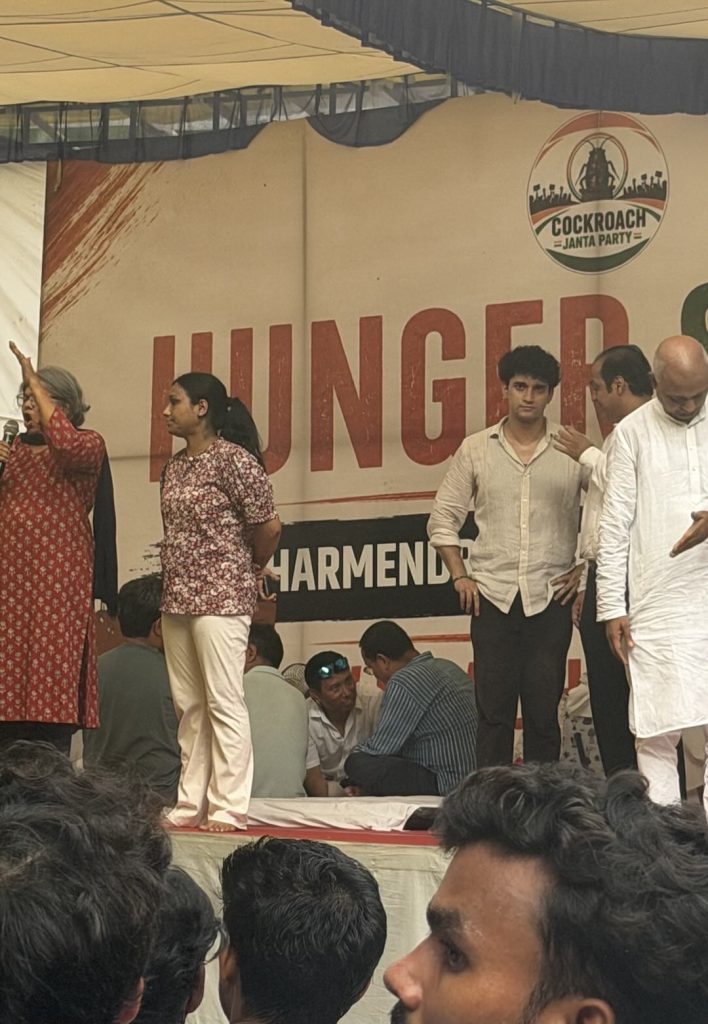
There were a number of dissenters from the progressive side too who did not fully agree with the CJP leaders’ ideology, tactics and certain decisions, and this critique had the potential to delegitimise the leadership and thus the protest. In a scenario where the leadership is dispersed, where there are no designated leaders, such critique often isn’t fatal for the mobilisation. But in the CJP’s case, it very well could have been, had it received popular uptake. Thus we can see that protest leaders bring certain advantages as well as vulnerabilities to a mobilisation.
I do not know how well versed Abhijeet Dipke or his colleagues are in social movement theory but they definitely are innovating on the past protest activities. As soon as Dipke’s tweet asking whether all the cockroaches would come together went viral, he began the efforts to put together an organisational structure. It could either be because he was aware of Jo Freeman’s canonical essay ‘The tyranny of structurelessness’[4]Freeman, J. (1972). The Tyranny of Structurelessness. Berkeley Journal of Sociology, 151–164. or because he had worked with a political party in the past. Whatever it may be, the CJP certainly has started a new phase in the internet-enabled protests by prioritising leadership roles and an organisational set-up.
Further reading: Morris, A. D., & Staggenborg, S. (2004). Leadership in social movements. The Blackwell Companion to Social Movements, 171–196.
Tejas Harad is the founder and editor of The Satyashodhak.
Notes
| ↑1 | Noelle‐Neumann, E. (1974). The Spiral of Silence: A Theory of Public Opinion. Journal of Communication, 24(2), 43–51. |
|---|---|
| ↑2 | The avant-gardes and the hardcores, though, do not get swayed by public opinion. But they tend to be a minority in a society. |
| ↑3 | CAA stands for Citizenship (Amendment) Act; NRC stands for National Register of Citizens. |
| ↑4 | Freeman, J. (1972). The Tyranny of Structurelessness. Berkeley Journal of Sociology, 151–164. |
Thanks Tejas. This was a good read and an example of how one can apply theory to real life events without making it academically dense. Your observations are spot on. I would also like your insights on how the mix of students from different caste and class backgrounds affected the protests.