
In the 1973 Hindi film Bobby, the song ‘Naa Mangoo Sona Chandi’ opens with the familiar line of ‘Ge ge ge ge re, ge re saiba’. The visuals are meant to depict the Goan life — its drunk, music loving, supposedly inept men, its lascivious women and the general excess of the dancing hamlet — contributing to the detrimental stereotype of Indian Catholic life. Similarly, in the 1991 film Dil Hai Ki Maanta Nahi, we hear the song ‘Galyan Sankali Sonyachi’. Once again, the visuals of the idealised Koli life are closer to the upper class notions of a fishing village than actual reality.
These representation not only obscure the day to day violence these communities face and their rich and varied cultural lives but also the origins of the songs. As someone who grew up in a middle class Catholic household in the 1990s’ Mumbai, we encountered these songs first-hand, as party mixes during weddings. Popular amongst such mixes were Goan dulpods like ‘Undir Mama Ailo’ , ‘Farar Far Zatai Ranant’ deknnis and ‘Aum Saiba Peltorhi Voitam’, Koli-geet such as ‘Galyan Sankali Sonyachi’ and ‘Nakwa Pori’, Damani-Portugese songs such as ‘Maria Pita Che’, South Canaran Konkani compositions like ‘Ami Dogui Shezara’ and ‘Ye Ye Katrina’.[1]See, Dias, Remy Antonio. “Marry ‘gods’, merry with ‘lords’, understanding enigmatic life of solitude of Goan devadasis through Dekhni songs.” Wordpress, 2016, … Continue reading
Bombay in the early 20th century had three distinct groups of Catholics — Goans, South Canarans and East Indians. All three were the result of proselytisation activities of various Catholic missionary orders on the west coast in the 16th and 17th centuries when the Portugese controlled a substantial part of the Konkan strip along the western coast.
It is necessary to address the linguistic diversities that are present in Konkani. The Goans and South Canarans, for example, speak several dialects of Konkani while the South Canara Catholics in Mangalore and Udupi speak a version of Konkani and Tulu. The East Indians are converts from the Bombay and Salcette islands and they speak a dialect of Marathi with Koli influences. The numerically smaller groups in the city include Tamil, Malayalam and Gujarati speaking Catholics.
My parents grew up as children of working class parents in Bombay in the 1950s. My grandparents had migrated from South Canara to benefit from the post-independence cotton mills boom — a pattern common to most Catholics immigrating from Goa and South Canara at that time. But no social categorisation in India is possible without an analysis of the jati or caste position. A majority of these Catholics were non-landholding but tenant farming agriculturist castes or part of indigenous tribes — fisherfolk, peasants or Shudra jatis (majority farm labourers and minority land owners), toddy-tappers (Bhandaris), salt pan workers (Agris), gardeners (Malis), Eurasians and a tiny number of Brahmins. Across communities, migration to Bombay always took place by ways of caste, kin and village connections.
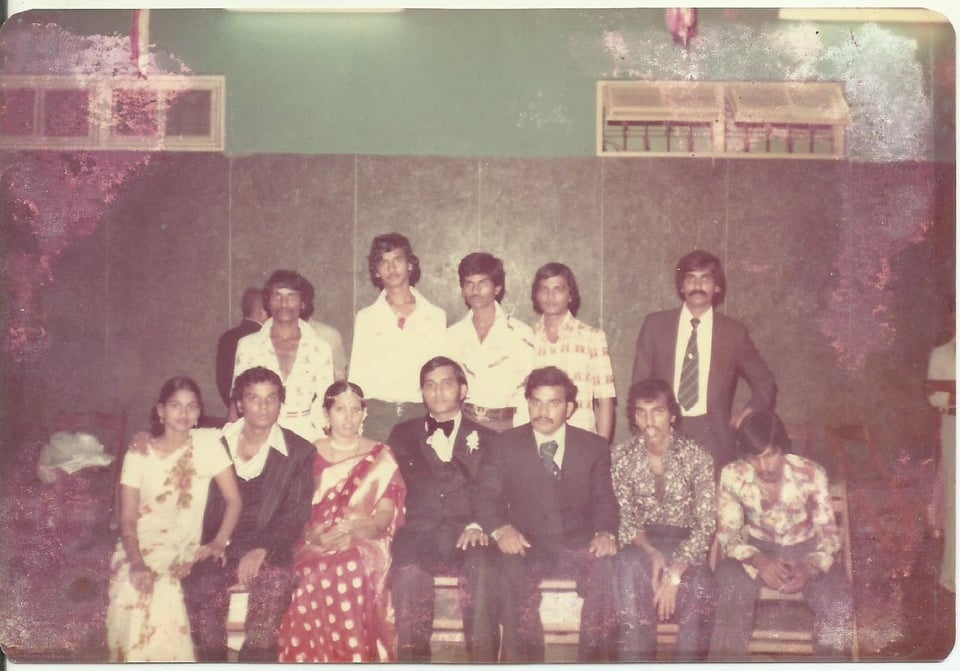
An image from my parents wedding in 1979 at Our Lady’s Hall, Hindmata in Central Mumbai (Courtesy: Author’s family archive).
The first migrations from the Catholic Goan and South Canara communities came from the minority (within the minority) bourgeois who had access to English education and who were landowners. Generally speaking, the Goans had been present in the city of Bombay from the mid-19th century. By the late 19th century, prolonged effects in land taxation laws under the British in the Madras Presidency started to show their effects. Along with the debts owed to landlords and moneylenders, agriculturist caste Catholics began to migrate to Bombay. The formation of Bombay as Urbs Prima in Indis due to the boom in cotton mills production that was fuelled by opium trade drew people across class and caste lines from all over India. The early documented migrants for the South Canara Catholics were primarily women and children who were expected to earn money in the city and send it back to the villages. In subsequent years, men started to migrate to the city and took up service jobs such as mill workers, taxi drivers, butlers, cooks and maids.
In his book, Recasting Caste, Hira Singh[2]Singh, Hira. Recasting Caste: From the Sacred to the Profane. Sage Publications India Private Limited, 2013. speaks of the danger of privileging only the religious dimensions of caste. By centering the religious experience of caste, the economic and political interests of smaller caste groups within larger groups get overshadowed. Such views that privilege religion also look at caste as transhistorical and in isolation of its material context, nor do they see the caste system in Islam or Christianity in India. The Catholics in this case were not a homogeneous identity, but were marked by several distinctions. It is only by understanding the material reality or their connections with land and livelihood that we can get closer to their subaltern consciousness.
Many of the traditional song compositions in these communities show a connection with manual labour, which the upper castes absolutely abhorred. It is also through their occupations in the villages that we come closer to understanding where the above-mentioned songs come from.
My grandmothers (Elizabeth and Carmen) had shorter stints working at the cotton mills before they were compelled to give those up by both patriarchal grandfathers (John and Joakim). My maternal grandfather was part of the weaving shed at Khatau Mills and my paternal grandfather was a lift man at the Nair hospital for the majority of his life. In previous writing I have attempted to provide the lacunae in understanding caste among Bombay Catholics, an institution still thriving in the Catholics till date.
Artistic creations of the working class
Rajnarayan Chandavarkar[3]From Neighbourhood to Nation: The Rise and Fall of the Left in Bombay’s Girangaon in the Twentieth Century. (2009). In R. Chandavarkar, History, Culture and the Indian City. Cambridge University … Continue reading wrote about an agriculturist caste and working-class culture at Girangaon. The writing presented the aesthetic and cultural activities at Girangaon primarily from the lens of this social positionality. What becomes clear is that there are distinct levels of cultural production related to class in the city and the development of art forms such as lavani, loknatya, and loksangeet were utilised as means to foster intimacy and consensus between various jatis outside the mill. Girangaon’s culture by the 1950s had a strong influence on the emerging Hindi cinema industry that appropriated and popularised these forms that created the popular masala style in later Bollywood cinema. Left-leaning activists and artists from groups such as the Indian People’s Theatre Association (IPTA) and Progressive Writers’ Association absorbed and learned from these working-class art forms.
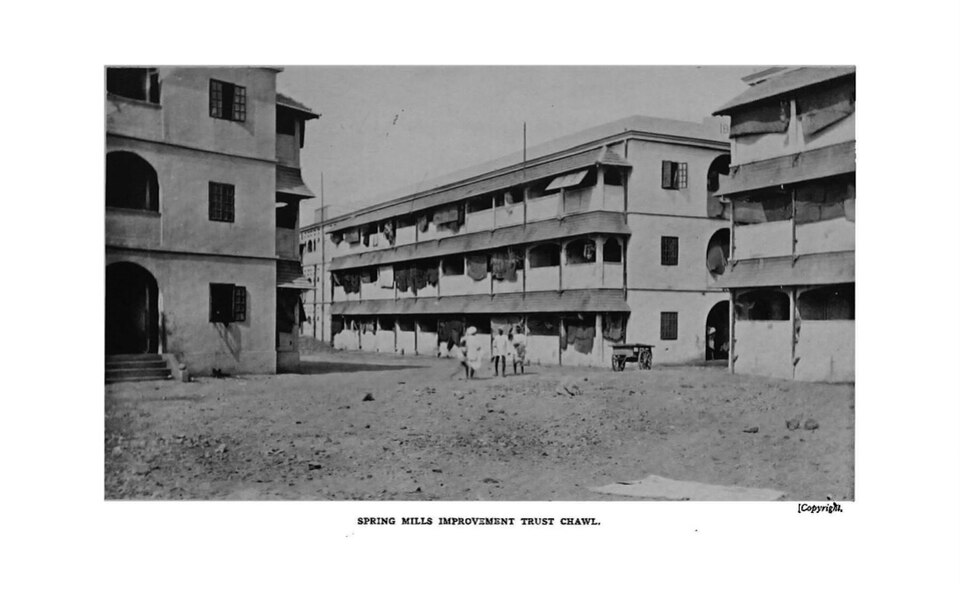
Image of the Bombay Improvement Trust blocks (Courtesy: Wikimedia commons)
Eager to know my own grandparents’ presence in such histories or participation in such artistic endeavours, I spoke to my mother who grew up at the Bombay Improvement Trust blocks at Agripada. My maternal family had been part of several cross-cultural activities with their Muslim, Jewish, and Marathi-speaking neighbours who increasingly started to affirm their religious identities.
The BIT Block #12 that they were part of was a broad mix of different classes — cab drivers, Afghan snow cream makers, kite string makers, mill workers, low level clerks, small business owners, moneylenders — and a veritable mix of languages such as Urdu, Hindustani, Hindi, Marathi, Gujarati and Konkani. One prominent cultural activity was a film night, along with dance performances and street plays that were organised during Ganesh Chaturthi festival for everyone in the neighborhood. Aside from statistical records there is not much written about the lives of working class Catholic communities in mainstream academia. Even when Catholics do appear in literature, the working class is either obscured by storytelling that tells us more of the aspirations of the then middle and upper classes and their cultural output.
Catholics of various caste locations, geographical locations and linguistic persuasions also had to confront the possibility of sharing status and power with others. The East Indians. Goans and South Canarans (to a lesser extent) have a remarkable series of identity affirmation that at least begins in the late 19th century and stretched all the way up to the 20th century. There even appears to be a class struggle taken up within the parameters of the right to ecclesiastical boundaries between Rome and Portugal or between the Propaganda and Padrado.
But through all these struggles, we see the wilful creation of distinctive art forms that are unique to the Catholic experience of agrarian caste backgrounds coming into Bombay. For example, Tiatr is a documented working class creation that draws influence from cultural activities on the Goan coast. Or the short fictions and poetry that were written in the little magazines such as Poinari, DIVO or Rakno, which detail the life of working class Catholics in the city of Mumbai. The affirmation of identity does not play out just in the church realm or the burgeoning print magazines. It plays out in the realm of music as well. One such example can be found in the Bombay masala mix: by analysing its content we can gain a better understanding of the working class Catholic life.
Participatory sounds of the Bombay masala mix
My mother got married in the late 1970s. By that time church-owned halls had become affordable for working class Catholics to rent for functions. This working class was also an aspirational middle class, due to a boost in income. The practice of renting halls became more common among the working classes by the late 1980s.
Each celebration was a gathering accompanied by live music. When I grew up in the 1990s live performances were also complimented by recorded music, but the songs continued to be reproduced and heard at almost every ritual celebration of the Catholic life; baptism, communion, confirmation and weddings were all imbued with the songs from the Bombay masala mix. Several musicians who performed these songs came from South Canara or Goa and we can clearly see their own relationship to agriculturist backgrounds.
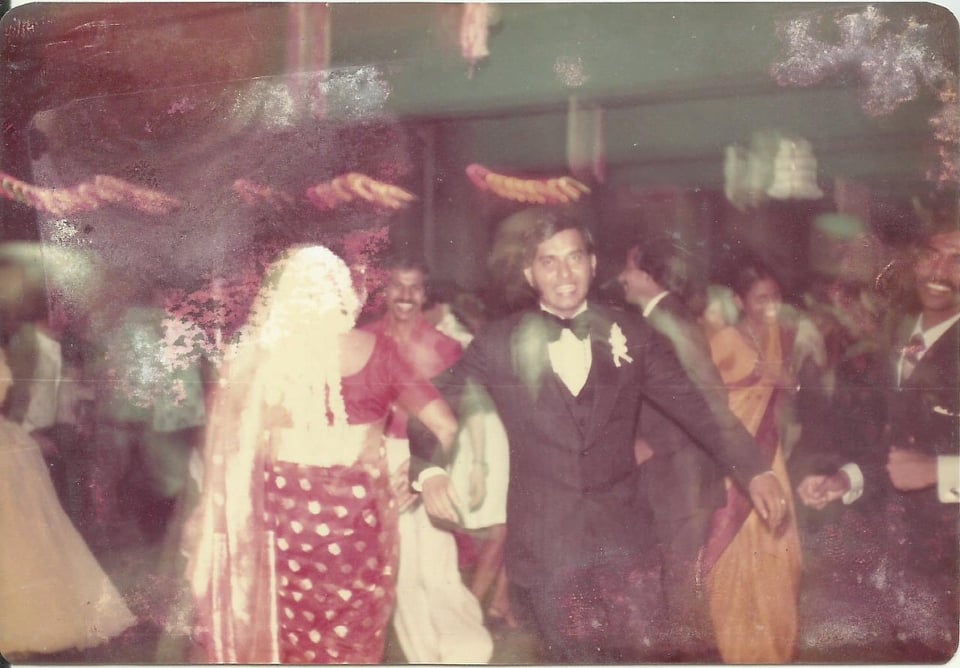
An image from the wedding of author’s parents in 1979 taken during the Bombay masala music mix (Courtesy: The author’s family archive).
The live band usually consisted of members from the local Catholics. The evening always began with couple-based dance music but there was a point when everyone was asked to join in dancing and singing as the mix usually began with Konkani. Songs like the dulpod ‘Undir Mama Ailo'[4]Due to space constraints briefly the translation of the lyrics are:You rat, my Uncle. Listen to what I am telling you,With the kittens of our litter, do not play the fool.Having cut a bamboo tree,And … Continue reading refer to a game of cat and mouse. The song is set in a playful manner and one reading of the song tells us of the conflict between social groups, predominantly the Eurasians (mesticos) and the rulers, in which we see a reference to a violent incident on September 21, 1890 where 23 civilians were fired upon by the soldiers of Governor Vasco Guedes.
In the deknni ‘Ge Ge Ge Ge Ge Ga Saiba” we hear a narration of the exploitation of the bailadeiras[5]The historian Remy Antonio Dias states that the Devadasis were virgins married to temple gods, but required to entertain village heads and principal villagers, satisfy carnal needs of dominant feudal … Continue reading who were subjected to a life of sexual servitude in service to various upper caste Hindu groups of the Bhattkars (landlords) and Desais (village chief). In the song, the woman offers various ornaments instead of her body but the lord’s appetite is only satisfied when he gets a kiss.
A song like ‘Galyan Sankali Sonyachi’ was taken from the indigenous fishing communities of the seven islands of Bombay city. The lyrics reflect the emphasis on gold among the Kolis, as a gold chain worn by a girl is admired. The song has patriarchal overtones as the woman does not respond or sing back but instead is courted by a man looking to be with her by asking the question, ‘Who does this girl belong to?’
The popularity of the song ‘Ye Ye Kathrina’, a Mangaluri Konkani dialect song produced in Bombay in the 1970s and sung by Helen D’Cruz and Henry D’souza, speaks of a couple in Bombay attempting to navigate the city. While the song utilises cliches about sexual innuendos, the woman rejecting the man and their eventual union, it is perhaps best remembered for the usage of the names of localities like Byculla and Bandra and the mention of the working-class snack Vada Pav. In an interview a few years ago, the singer Helen D’Cruz mentioned the song was translated into Sinhalaese and Chinese illustrating its migratory patterns.[6]D’souza, Alfie. “Ye Ye Katrina’ Fame Konkani Singer Helen D’Cruz- An Exclusive of a Mesmerizing Singer.” Mangalorean, 15th February 2020, … Continue reading
Other popular songs include ‘Maria Pitache,’ which is a blend of Portuguese and Konkani words. Finally, the renowned song ‘Bombay Meri Hai’ was composed by a Parsi — Mina Kava — and sung by Uma Pocha. It was equally famous within the Parsis, and grew in popularity as it honoured the diverse people and food cultures of the city.
Cultural cohorts and social positions
In his work on the social aspects of music, Thomas Turino defines participatory sound styles as “a special type of artistic practice in which there are no artist-audience distinctions, only participants and potential participants, performing different roles.” Despite a dedicated area provided to the band, the audience freely moved, they danced and sang loudly, actively participating and shaping this activity. Women were expected to be part of this and everyone in the assembled group participated. There were no pre-choreographed dance sequences, thus all movement by the audience was improvised.
In his definition of musicking, Christopher Small[7]Small, Christopher. Musicking: The Meanings of Performing and Listening. Wesleyan, 1998. says that, “To music is to take part, in any capacity, in a musical performance, whether by performing, by listening, by rehearsing or practicing, by providing material for performance (what is called composing), or by dancing.”
In my observations the musical practices as articulated by Small and Turino above do not apply neatly to the Bombay masala mix but they do provide unique readings of a musical context that has been largely understudied. I refer to Thomas Turino’s[8]Turino, Thomas. Music as Social Life. The University of Chicago Press Books, 2008. cultural cohort[9]He defines cultural/identity cohorts as a common ground through a common class, gender, occupation, colour, experiences, habits, political, religious and ethical beliefs and activities. and cultural/identity formation[10]He defines cultural formation as a group of people who have a majority of habits that constitute most parts of each individual member’s self. concepts to further the understanding of these practices. The Bombay masala mix allowed Catholics who came from similar cultural/identity cohorts (gender, religious, caste and class) but with differences in cultural formations (geography, rituals, language and dietary preparations) to create a homogeneous Catholic cultural identity in Bombay while retaining their individualities that marked these groups.
In a country where gender, caste, class and religion are the primary markers of identity, there were no lines of distinctions between Goans, South Canarans or East Indians at such moments. By resolving broader differences (even temporarily) it created solidarities. This is not to suggest that such a cultural cohort was created exclusively through musicking, but rather that it was one of the ways by which the Catholics could find a union, outside of the politics of the church.[11]Further research into ritual specificities, diets and language may provide greater insights. As a category of participatory performance, such events helped foster a ‘sense of social synchrony, bonding and identity inclusion’ for the various communities in Bombay. Over a period of time boundaries started to slowly melt down through inter-geographical marriages.
Most importantly, despite the patriarchal nature of the lyrics, the masala mix has gone beyond religious boundaries, finding use and newer mixes in every group that has a use of it. Over time the masala mix has gone beyond religious boundaries, finding use and newer mixes in every group that has a use of it. In many cases the songs have been permanently severed from their material origins and have now undergone changes in their structure as technologies of reproducing music have changed. This is a situation noticed even in the 1980s in Calypso and Sinhalese Baila music as songs travel for popular consumption, they also begin to lose their specificities.
Epilogue
The masala mix music carries on in different parts of the world and as we see, it does not belong to a single group, religion, caste or even nation. As the Catholics experienced this collage of music, it strengthened its cohesion as a group in society. Even when the geographical contexts of its participants were not the same, the sounds shared provided a sense of certainty and security.
These forms of artistic expression cited common values and lifestyles by identifying with a larger religious Portuguese Catholic identity, but by drawing from a shared caste location the working class was able to relate to each other. The material basis of their existence provided another layer of common grounding, not to mention their common interests with the economic and political. Music forms a core component of people’s lives but it also is an important identity marker. The Bombay masala mix provided a cultural glue of sorts to help Catholics of diverse backgrounds and jatis overcome their anxiety. Over time it allowed other groups and individuals in the city who did not identify with the music to also form a bond with it.
Elroy Pinto is a film-maker and researcher based in Mumbai.
Notes
| ↑1 | See, Dias, Remy Antonio. “Marry ‘gods’, merry with ‘lords’, understanding enigmatic life of solitude of Goan devadasis through Dekhni songs.” Wordpress, 2016, https://lisbon2016rh.files.wordpress.com/2015/12/onw-01961.pdf. Accessed 11 01 2021. |
|---|---|
| ↑2 | Singh, Hira. Recasting Caste: From the Sacred to the Profane. Sage Publications India Private Limited, 2013. |
| ↑3 | From Neighbourhood to Nation: The Rise and Fall of the Left in Bombay’s Girangaon in the Twentieth Century. (2009). In R. Chandavarkar, History, Culture and the Indian City. Cambridge University Press. |
| ↑4 | Due to space constraints briefly the translation of the lyrics are: You rat, my Uncle. Listen to what I am telling you, With the kittens of our litter, do not play the fool. Having cut a bamboo tree, And cut a branch of it, And what a big flock, Of rats from Margão. |
| ↑5 | The historian Remy Antonio Dias states that the Devadasis were virgins married to temple gods, but required to entertain village heads and principal villagers, satisfy carnal needs of dominant feudal elements who sought their services, yet forced to lead life of seclusion near precincts of temple complexes with very restricted access to means of living. Such women were referred to largely as bailadeiras by Portuguese from the sixteenth century and belonged to Hindu sub-caste which was marginalised to great extent due to socio-religious factors. |
| ↑6 | D’souza, Alfie. “Ye Ye Katrina’ Fame Konkani Singer Helen D’Cruz- An Exclusive of a Mesmerizing Singer.” Mangalorean, 15th February 2020, https://www.mangalorean.com/ye-ye-katrina-fame-konkani-singer-helen-dcruz-an-exclusive-of-a-mesmerizing-singer/. Accessed 11 01 2021. |
| ↑7 | Small, Christopher. Musicking: The Meanings of Performing and Listening. Wesleyan, 1998. |
| ↑8 | Turino, Thomas. Music as Social Life. The University of Chicago Press Books, 2008. |
| ↑9 | He defines cultural/identity cohorts as a common ground through a common class, gender, occupation, colour, experiences, habits, political, religious and ethical beliefs and activities. |
| ↑10 | He defines cultural formation as a group of people who have a majority of habits that constitute most parts of each individual member’s self. |
| ↑11 | Further research into ritual specificities, diets and language may provide greater insights. |