

Since moving to the United States three years ago I have become more appreciative of Marathi culture. As such I find refuge in Instagram videos by Marathi creators to satiate my nostalgic self, scrolling my FYP (For You Page) between work and household chores multiple times during a day. One thing that I find the most precious about my exploration of Marathi content over the last two-three years is the number of dialects and accents I have been exposed to.
I grew up in a remote village in Palghar and later lived in Mumbai for many years. Also, in all these years I rarely travelled to other parts of Maharashtra. As a result, for most of my life I encountered a limited number of dialects. It was on Instagram, for the first time, that I heard a myriad of Marathi dialects on a daily basis — Ahirani, Varhadi, Malvani, Kolhapuri and others. Many Marathi content creators have developed their niche in these dialects, making lifestyle content where their dialect is their USP (unique selling point).
While Marathi dialects flourish in the social media ecosystem, they remain sequestered as folk speech in public life. On the other hand, the ‘standard Marathi’ (प्रमाण भाषा) dominates news media, literature, public sphere discussions and public institutions. When the dialects appear in novels, movies and TV shows, they index the social and regional status of the character (the web series B.E. Rojgaar is a good example of this.). Many a time they are also employed in a stereotypical way — often assigned to the villains, domestic workers, lower castes, a clownish figure or a country bumpkin.
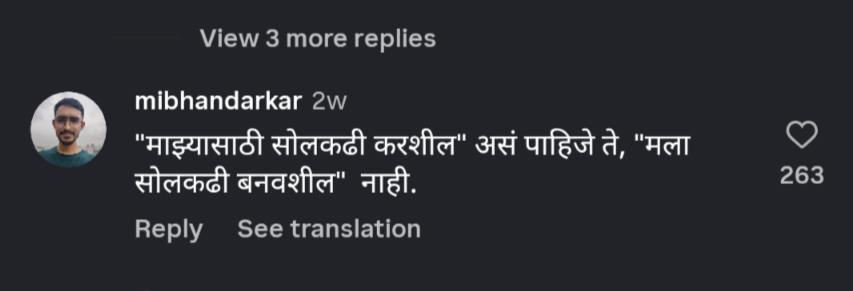
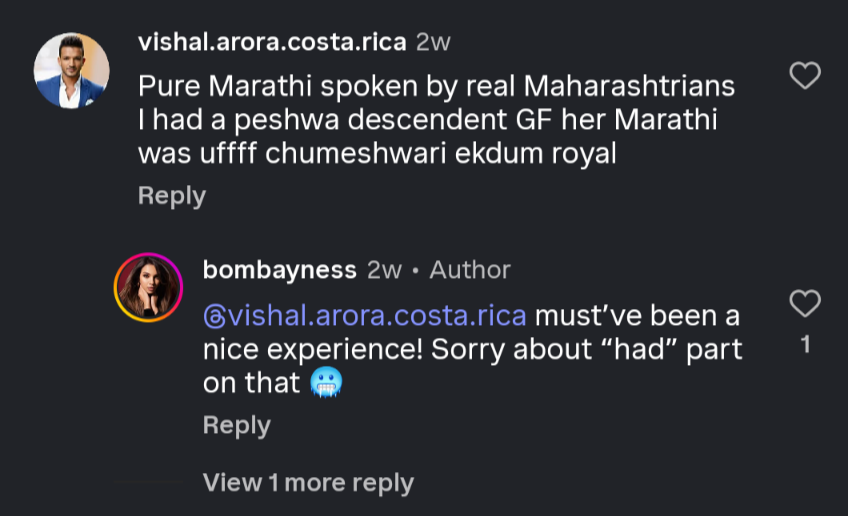
A majority of Brahmins and Brahminized non-Brahmins consider standard Marathi as the only appropriate dialect for use in not just formal spaces but also in daily speech. On Instagram, Brahmins routinely cosplay a language cop, constantly pointing out how other people’s Marathi is ‘impure’ and ‘grammatically incorrect’.
This is a continuation of their attitude towards Marathi speech in general. In her semi-autoethnographic research article, Ankita Bhatkhande narrates how her grandmother would sternly admonish her whenever she brought ‘non-Brahmin speech’ home from the school.[1]Bhatkhande, A. (2023). ‘Do Not Talk Like the Other Castes’: Language and Everyday Casteism in a Marathi Brahmin Household in Mumbai. In Caste in Everyday Life: Experience and Affect in Indian … Continue reading She further states that people who do not use the retroflex nasal ‘ṇa’ (ण) are identified as non-Brahmins and pejoratively labelled as ‘Aani-pani’. Sociolinguist Sonal Kulkarni contends that the dental nasal na (न) has always been identified as a stereotype of non-Brahmin speech and is heavily stigmatised.[2]Kulkarni, S. (2000). Caste and Class: Reassessing their significance in investigating sociolinguistic variation and change in urban India. In Reading Working Papers in Linguistics (pp. 95–122).
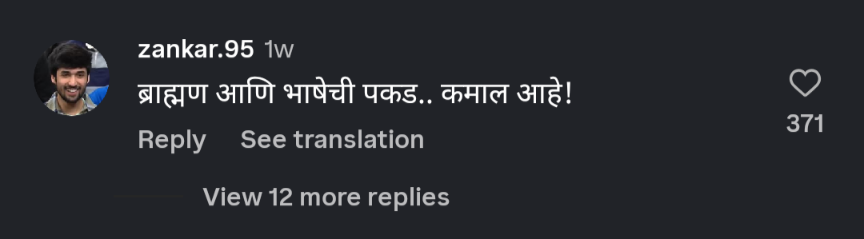
The puritan Brahmins believe that Marathi speakers should follow grammar books and dictionaries when they communicate. But they forget that grammar books and dictionaries are historical artefacts produced by administrators and educationists for specific purposes and agendas.
The ‘standard Marathi’ took shape in the colonial 19th century as a collaborative project between the Europeans and Marathi upper castes. Scholars like K. S. Rajyashree[3]Rajyashree, K. S. (1991). Consequences of Printing on the Written Marathi. Indian Journal of Applied Linguistics, 17(1), 109–125. and Prachi Deshpande[4]Deshpande, P. (2023). Scripts of Power: Writing, language practices and cultural history in Western India. Permanent Black and Ashoka University. have shown the role played by Englishman Thomas Candy in standardising Marathi spellings (orthography) and words (lexicography). The push towards standardisation in the 19th century also led Candy and others to select the dialect spoken by Pune Brahmins as the preferred one for written use. “The standard dialect is a historical development of the speech variety of the educated Brahmins in Pune (Poona),” states sociolinguist Sonal Kulkarni-Joshi.[5]Kulkarni-Joshi, S. (2023). Variation and Change in Dialects of Marathi: A Social-Dialectological Approach. In P. Chandra (Ed.), Variation in South Asian Languages: From Macro to Micro-Differences … Continue reading
The language specialists who spearheaded the standardisation project, such as Thomas Candy and Dadoba Pandurang, were well aware of the diversity of speech in Marathi. But the crowning of Pune Brahmin dialect as ‘standard Marathi’ nevertheless created a hierarchy; and we still live with the consequences of that ‘original sin’.

Recently, historian Shailaja Paik wrote about the Brahmin obsession with retroflex consonant ण (ṇa), which is absent in the majority of Marathi dialects. She correctly notes that the nasal ṇa (ण) acts as a line separating Marathi speakers whose speech is legitimate and dignified and those whose speech is illegitimate and coarse. French sociologist Pierre Bourdieu calls language an instrument of power because people speak “not only to be understood but also to be believed, obeyed, respected, distinguished.”[6]Bourdieu, P. (1977). The economics of linguistic exchanges. Social Science Information, 16(6), 645–668.
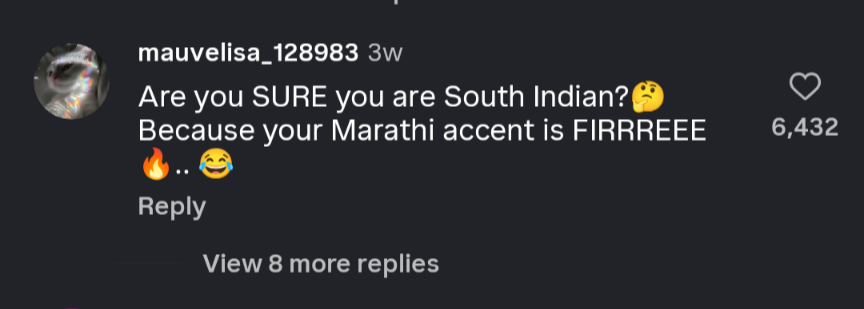
Whenever someone on Instagram does not bother with the normative expectations of Brahminical speech, puritan Brahmins magically appear in the comments section to admonish them and teach them the ‘pure’ and ‘grammatically correct’ Marathi. They reward non-Marathis and non-Brahmins who correctly pronounce retroflex consonants ळ (ḷa) and ण (ṇa) with praise and punish with abusive comments those who do not.
Language prescriptivists show complete ignorance of the fact that language can only be understood in its use. Language can not be contained in dictionaries and grammar books; communication is a highly contextual act and people pay close attention to situational factors in their meaning making. Language does carry the weight of culture but people are very creative in their day-to-day communication; further, a language actively responds to social and material changes such as new ideas and technologies, labor processes and movement of people. Thus, our vocabulary is ever evolving. Anybody who pays attention to slang knows this very well.
If you have ever come across Instagram reels by Americans, you may have seen parents making videos with words like skibidi, gyatt and sigma to tease their Gen Alpha kids (kids born after 2010). The Gen Alpha has adopted certain slang words that are incomprehensible to the rest of the population, generating a lot of curiosity among older people. Each generation develops its own slang/vocabulary that is distinct from the earlier generation. That’s the beauty of language — it is always changing as people constantly modify it to suit their needs.
That is why, attempting to impose a single language on people is futile. People do not live homogeneous lives, and language shows differences as per region, class, gender and age. If people’s lifeworlds are different, their languages tend to be different too. Even if you impose a single language on people, within decades that language will start showing differentiation as people modify it to suit their local environment and needs.
When Brahmins insist that पोळी (poḷī) is the correct word for wheat roti and चपाती (capātī) is incorrect, they deny the diversity of speech and disrespect people’s local cultures. The connection between a sound (or word) and its meaning is socially constructed — it is not natural, nor eternal. Russian philosopher Mikhail Bakhtin captures this quite well when he says,
Depending on the context of the utterance, the sentence “He died” can also reflect a positive, joyful, even a rejoicing expression. And the sentence “What joy!” in the context of the particular utterance can assume an ironic or bitterly sarcastic tone.[7]Bakhtin, M. M. (2010). The Problem of Speech Genres (V. W. McGee, Trans.). In Speech Genres and Other Late Essays (pp. 60–102). University of Texas Press.
In a rejoinder to Paik, computer science professor Aalok Thakkar argued that we need retroflex consonants such as retroflex nasal ‘n’ (ण) because they are essential in differentiating meanings of words. Thakkar gave the example of मन (mana) and मण (maṇa) where मन means mind and मण is a unit of weight. But he missed the important point that there is no natural connection between a sound and meaning.
The principal teaching of sociolinguistics is that meaning-making is a social process. Further, the meaning is simultaneously influenced by the context in which the communication is taking place. We see both these points being stressed again and again by the foundational theorists of sociolinguistics — from Saussure to Voloshinov, Bakhtin, Wittgenstein, J L Austin, Bourdieu to Ruqaiya Hasan.

In my dialect of Marathi (Thane-Palghar region), we don’t have the retroflex nasal ṇa (ण) but I have never come across a peasant in the village who has confused मन as mind versus मन as unit of weight in actual speech. मण (maṇa) of standard Marathi is regularly used to describe the weight of rice in my hometown but pronounced as मन (mana). Humans pay attention to their context while engaging in the meaning-making process.
A language doesn’t need to have all the sounds in the world for effective communication. There is no language in the world that has all the sounds that linguists have catalogued from all the human languages. It is perfectly fine if some Marathi dialects do not have retroflex consonants ळ (ḷa) and ण (ṇa): it is neither a sign of impoverishment nor incompetence. Once one understands that ‘standard Marathi’ was a historical invention and privileged a specific dialect over all others, language prescriptivists will realise the arrogance inherent in their puritanism. We should embrace the diversity in our languages — that’s what makes us human.
Notes
| ↑1 | Bhatkhande, A. (2023). ‘Do Not Talk Like the Other Castes’: Language and Everyday Casteism in a Marathi Brahmin Household in Mumbai. In Caste in Everyday Life: Experience and Affect in Indian Society (pp. 271–290). Springer. |
|---|---|
| ↑2 | Kulkarni, S. (2000). Caste and Class: Reassessing their significance in investigating sociolinguistic variation and change in urban India. In Reading Working Papers in Linguistics (pp. 95–122). |
| ↑3 | Rajyashree, K. S. (1991). Consequences of Printing on the Written Marathi. Indian Journal of Applied Linguistics, 17(1), 109–125. |
| ↑4 | Deshpande, P. (2023). Scripts of Power: Writing, language practices and cultural history in Western India. Permanent Black and Ashoka University. |
| ↑5 | Kulkarni-Joshi, S. (2023). Variation and Change in Dialects of Marathi: A Social-Dialectological Approach. In P. Chandra (Ed.), Variation in South Asian Languages: From Macro to Micro-Differences (pp. 207–236). Springer Nature. https://doi.org/10.1007/978-981-99-1149-3_9 |
| ↑6 | Bourdieu, P. (1977). The economics of linguistic exchanges. Social Science Information, 16(6), 645–668. |
| ↑7 | Bakhtin, M. M. (2010). The Problem of Speech Genres (V. W. McGee, Trans.). In Speech Genres and Other Late Essays (pp. 60–102). University of Texas Press. |
So? Anyone can speak in any language. It’s about a Marathi so they spoke. But targetting one caste’s language speaks volumes about your inferiority complex. Just because others languages in their day to day use are evolving doesn’t ours should too. The use of GenZ and Gen Alpha languages, don’t have to be the norm. If you are secure in your own skin and language you wouldn’t have been intimidated by others. Also, what’s wrong with grammar. If you learn English you will be corrected often times for grammar mistakes. Attacking someone purely because of their caste origin and their authority over the language they know better doesn’t mean you have to feel insecure.
Lovely article. I learnt a few new things. Well researched.